
All posts in Business finance

Business Loan Payment Calculator vs. MCA Payback

Will you sign a financing agreement if you aren’t told the estimated monthly cost to your business? Before you consider MCA financing or a term loan, the payment should be converted to a cash-flow number the business will understand. A business loan monthly payment calculator does a reasonable job estimating the scheduled monthly payment on an amortizing loan. A business loan amortization calculator can actually show the change in principal and interest over the life of the loan. A merchant cash advance works differently, and a factor or purchased amount shouldn’t be used to calculate a business loan. The calculation intends to ensure the business is not and will not become financially unviable.



Why Calculating Payments Before Borrowing Matters

Financing decisions are made in the moment. A machine breaks down, payroll needs funding, deposits need to be made to suppliers, and a growth opportunity requires an investment with a date. The finance amount approved is the most important number to the first-time financing decision maker. This is incorrect thinking. The payment and total cost determine the impact financing will have on the business cash flow situation.

The financing payment has to be considered in relation to the business’s normal operating expenses and the profit that will be generated by the use of the financing. A financing payment that consumes most of the expected profit should be carefully analyzed.

Remember to review the financing payment in a slow month. Reduce sales, delay receiving a payment from a large customer, and add an unexpected expense. If adding the financing payment leaves the account overdrawn, the financing you want to secure may be too aggressive.

How a Business Loan Monthly Payment Calculator Works

A monthly payment calculator determines the scheduled payment of an amortizing loan through the principal, interest rate, and term that the borrower inputs. With a fixed-rate loan, the payment amount would remain the same, and the interest portion of the payment would decline while the principal portion would increase.

This is exemplified in an SBA example. The majority of the 7(a) term loans are repaid by monthly principal and interest payments from business cash flow. Fixed-rate payments will remain constant. Variable rate payments can change as interest rates change. When projecting payments, the type of rate is important.

The fees should be noted when using the calculator, as the loan amount stated may not be the loan amount that is given if the origination or closing costs are subtracted. The owner should consider the total payments made and review the net proceeds of the loan rather than just the stated principal.

Amortized Loan Payments vs. MCA Payback

A merchant cash advance (MCA) is unique in that it is normally not structured like an amortizing loan. An MCA will identify the principal advanced, a purchased amount, or factor, and the manner in which collections will be made. The FTC considers MCAs to be a type of high-cost, short-term financing in which the financing company buys a fixed amount of future receivables.

An MCA factor should not be equated to an interest rate. A factor of 1.30 indicates how much of the advance was purchased, but it has no APR consideration. The provider’s collection methodology will determine what the annualization of the cost will be.

When considering MCA financing, determine the net cash received, total purchased amount, fees, estimated collection frequency, and estimated collected period. Compare the cash outflow each week to payroll, suppliers, taxes, and rent. Businesses should know the shortest period in the cash cycle rather than only the total at the end.



What an Amortization Schedule Can Show You

A business loan amortization calculator shows the opening balance, payment, interest, principal reduction, and the ending balance for each period. This will help the owner understand how the debt goes down over the course of the loan and what the remaining balance would be on a given date in the future.

The schedule can help with refinancing decisions too. If a business has a lot of expensive loans, the owner can look at the remaining balance and payment schedule for each loan versus the proposed loan for consolidating the debt. Money Man 4 Business says they usually have to do that type of comparison for MCA and other loans for refinancing business debt.

With loans, the monthly payment can go down if you have a longer term for the loan, but overall you end up paying more in interest. Going the other direction, a shorter term for the loan will lower the total interest on the loan, but the monthly payments will increase. The best option, considering the cash flow of the business, will be to select one of these options.

What to Calculate Before You Apply for MCA Financing

Before signing, jot down six numbers: cash deposited, total amount to be collected, all fees, expected repayment duration, how many times to collect, and the lowest cash balance the business expects during the repayment duration. It is a concern if the provider cannot explain the obligation.

If there is a true APR or an annualized cost available, use those as rate comparisons. Review the agreement to see if there are reconciling’s, personal guarantees, liens, or other obligations. Commercial financing disclosure provisions vary by jurisdiction, so the business should not assume they will see cost disclosures the same way with each offer.

Money Man 4 Business offers monthly payment financing, SBA programs, lines of credit, term loans, and debt refinancing. Some options can be from 1 to 25 years, depending on the product and underwriting. The company claims that clients can have CFO-level advice to analyze the proposed payment to see if it fits the business.

How Money Man 4 Business Uses the Numbers

Money Man 4 Business thinks financing comparison should focus on actual payment terms. A business may get excited about the approval amount, but Money Man 4 Business analyzes how the new payment will affect current debt and everyday business costs, which is especially important when there are already several short-term obligations.

The published programs include term loans, SBA financing, lines of credit, working capital, equipment financing, and refinancing. Some programs offer financing with payments that are collected monthly, and financing terms can be from 1 to 25 years, if underwritten. This makes it possible for the cash flow analysis to compare short-term vs. longer amortized payment obligations.

When considering consolidation, the new payment is not the only relevant number. The owner can remove the current financing obligations and add the new fees, new interest, and the remaining balance on the current loan. Money Man 4 Business believes that, in most cases, qualifying restructures can significantly lower the cost of high-cost debt, but the real answer should be determined based on the analysis of the actual numbers.

Frequently Asked Questions

Does a loan calculator show every financing cost?
Not necessarily. A calculator may estimate principal and interest but exclude origination, closing, broker, guarantee, or other fees. Use the actual offer for the final comparison.

Can I use a business loan monthly payment calculator for an MCA?
Not directly. MCA pricing and collection structures differ from amortizing loans, so the advance should be compared using net proceeds, total payback, collection timing, and annualized cost where available.

Why use a business loan amortization calculator before refinancing?
It helps show the remaining balance and payment path on the existing debt so the owner can compare it with the proposed refinance.

Do the Math Before the Money Hits the Account

Calculating the monthly payment for a business loan puts the financing into real numbers. This allows you to compare it with your cash flow. The same is true for a business loan amortization calculator. With a Merchant cash advance, a different calculation is used, but the goal is the same: Understanding the amount that leaves the business and when.

Prior to the application for MCA financing or any other type of loan, calculate the payment in a typical month and also in a more challenging month. Money Man 4 Business helps owners evaluate structured financing and consolidation options so the decision is based on affordability, not just on how quickly the financing is approved.

Construction Business Loans vs. MCA Funding

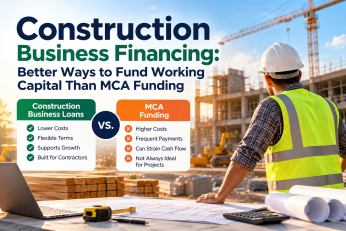
The payment for your workers is due Friday, but the supplier needs the payment today. The next project draw will not be available for three more weeks. How do you fund the gap? There are many challenges in construction financing that often have more to do with timing than with the volume of work. There are business loans and construction working capital loans that construction organizations can use to finance payroll and materials, mobilization, and receivables. While MCA funding appears to be a quick short-term solution to the funding gap, companies that are project-based need to be very careful about how they structure repayment, as it may start before the next progress payment comes. The financing should help the contractor reach the next cash inflow rather than make the gap harder to cross.


Why Construction Companies Need Working Capital

Contractors typically spend money in advance. Whether it’s labor, subcontractor costs, insurance, permit costs, fuel costs, deposits for materials, rental equipment, or the cost to mobilize to a job site, contractors incur many expenses before the owner receives the draw or invoice payment. As such, a successful project can cause financial issues for contractors due to the need for cash flow to cover operating expenses.

Furthermore, materials have been erratic. The Associated General Contractors of America reported that the producer price index for inputs to new nonresidential construction was 7.1% higher in June 2026 than a year earlier, while bid prices were up only 3.5%. That spread shows many contractors were taking a hit and eating a big portion of the increase instead of passing along the entire cost to the customer.

Unexpected increases in steel, aluminum, copper, fuel, or other costs can consequently decrease the available cash for the rest of the job. Financing may keep the project going, but those costs need to be added to the project as part of the margin, instead of treating it as free working capital.

Common Construction Financing Options

Construction business loans contain many options such as term loans, lines of credit, equipment financing, SBA loans, receivables-based financing, and project-specific working capital structures. The right option depends on whether the need is one asset, recurring payroll, a delayed receivable, or an entire contract that requires an up-front outlay.

SBA programs show how financing can be constructed in line with project cash flow. Contract CAPLines can cover costs associated with eligible contracts. Working capital lines can fund receivables, inventory, and projects. While they require supporting documents, they are constructed for identified company purposes.

The contractor should time the financing with the expected payment. If a payment is expected in 45 days, it could be drawn as a short-term payment. If the company is purchasing a machine that has a long useful life, a longer-term equipment loan could be more appropriate.

Working Capital Loans vs. MCA Funding

Some business working capital loans have a fixed term, fixed rate, and fixed payment schedule. A line of credit may offer a borrowing limit and the ability to borrow repeatedly and make repayment draws. These structures can work well for contractors who have payroll and material costs that span billing cycles of project work.

MCA funding is often structured around the last couple of weeks of working capital and is a lightning-fast funding option. The associated higher cost and frequent collections should be carefully considered. Construction companies who have large, infrequent cash flows may be at the greatest risk with daily or weekly withdrawals, which prompts a large irregular funding draw to be paid in the future.

When comparing the funding options, the timing of three cash flow events should be analyzed. When the cash inflows from a contract pay the labor and material costs, and when the customer is expected to pay, should be evaluated. If financing begins collecting payments before a contract payment is made to the customer, the timing of the cash inflows should be analyzed to determine the available cash balance.


Managing Project-Based Cash-Flow Gaps

A project cash-flow forecast should be done job by job. List material costs, subcontractor payments, payroll, equipment rental, insurance, retainage, change orders, and expected draws. Finally, add the financing payment. The model should anticipate that an approval, inspection, or customer payment may occur later than expected.

Retainage should be addressed separately because a contractor may have finished the work and paid the costs but is still waiting for a portion of the project revenue. Using short-term financing to cover a long retainage period, which is likely to have a substantial final payment, can become very costly.

If there are multiple draws already being taken from the operating account, taking on another draw may mean there is less cash available to start a new project. Money Man 4 Business focuses on refinancing and consolidating high-cost, multiple payment programs into one low payment structure, in which the qualifying programs may be substituted.

Matching Financing to Project Timelines

The best construction financing matches the project’s financing needs. Construction financing for a 30-day project shouldn’t result in 10 years of construction financing. Likewise, for a 7-year construction project, financing shouldn’t be a few months of aggressive collections. The financing term should align with the purpose of the financing.

Money Man 4 Business provides working capital, equipment financing, term loans, SBA programs, lines of credit, and cash refinancing services. Some programs can range from 1 to 25 years, based on the purpose and the underwriting. The company also states clients can work with an experienced CFO to review cash flow and debt.

For contractors, this review should consider one important question: can the business keep cash flow positive by paying suppliers and workers even if the next payment on a project is delayed? If the answer is no, the financing structure should not be finalized.

How Money Man 4 Business Helps Contractors Review Debt

Money Man 4 Business examines a construction project financing scenario by reviewing debt and job schedules simultaneously.  Many contractors have planned work, but still experience financial stress due to the timing between payroll, material expenses, and customer draws. Adding an aggressive short-term obligation can worsen the timing problem.

Money Man 4 Business publishes various working capital financing solutions, including equipment financing, SBA financing, line of credit, term loans, and refinancing solutions. Money Man 4 Business offers solutions to contractors with multiple MCAs and other short-term financing commitments to help consolidate several obligations into one financing commitment with a more predictable monthly obligation.

Money Man 4 Business suggests clients can engage in an advisory capacity with a CFO. This service for construction clients may offer a review of project backlog, gross profit per project, receivables with retainage, material and subcontractor obligations, equipment, and the financial timing of draws. Financing should help a client reach the next cash flow goal for a project without using all of the cash to reach the goal.

Constructors should separate project profit from available cash flow. A job can have a significant projected margin, while the contractor still has to pay the labor, provide the materials, and cover retainage for several weeks before the final payment is received. Making a financing decision based on project profit can create a significant gap between anticipated project profit and actual liquidity. A cash flow schedule should be prepared with the job cost report in order to understand the timing of new obligations undertaken by the contractor.

Frequently Asked Questions

What can construction working capital cover?
Depending on the product, it may support payroll, materials, subcontractors, mobilization, equipment rental, insurance, receivable gaps, or other eligible operating costs.

Are Business working capital loans the same as equipment loans?
No. Working-capital financing supports operations and timing gaps, while equipment financing is generally tied to a specific asset or purchase.

Why can MCA funding be difficult for contractors?
Project revenue may arrive in large, uneven payments. Frequent collections can drain the account while the contractor is still waiting for a draw or invoice payment.

Build the Financing Around the Project Schedule

Construction work loans help contractors meet their obligations for payroll and suppliers to get to the next project step. Consider the total cost, payment frequency, and timing of customer payment for construction working capital loans and MCA funding.

Money Man 4 Business can help contractors look at equipment financing and debt consolidation along with business working capital loans. The best structure helps contractors complete projects even when there are increased project costs or if payment milestones for construction progress are achieved later.

Retail Business Loans vs. Same-Day MCA Funding

What cash is on the shelves? Retail financing typically begins with a cash flow mismatch. For example, a store may have high-value, strong-selling inventory and may even be selling more given the busy season, but is still cash flow negative because cash has not yet been recouped from purchases made. In such instances, repayment of retail business loans can be stretched over time, and same day business funding can address an urgent fund need for making a stock purchase or a repair. A merchant cash advance can be quickly made available; however, the business owner should consider whether he is ready to deal with the cash being rapidly eroded because of frequent collections before the inventory that was bought and sold sells out.


Why Retail Businesses Seek Financing

Retail businesses spend cash before earning it back. Inventory has to be ordered, Freight has to be paid, staff schedules have to be kept, marketing has to be done, and the store has to cover rent and utilities even if the merchandise is in boxes. For these reasons, added business may give a cash flow problem rather than solving the problem.

With the retail environment the way it is, timing is critical. The U.S. Census Bureau predicts retail and food service sales for the United States for July 2026 to be $763.6 billion, an increase of 5.0% from July 2025. Down the stretch from July, advance retail inventories were estimated at $831.3 billion, an increase of 3.0% from the same period the previous year. Large inventory levels support future sales; however, large inventory levels also represent cash flow that has already been spent.

The 2026 Small Business Credit Survey from the Federal Reserve Banks found that challenges with tariffs were particularly prevalent in retail and were reported by 69% of retail businesses. When a retailer’s costs increase, owners will likely require more cash to buy the same inventory.

How Same-Day and MCA Funding Works

Same day business funding is a more general term compared to a single uniform product. The term may be used differently by each provider to represent a loan, line of credit, cash advance, or other financing product with simplified underwriting. As far as cost and repayment structure, just because funding is same-day doesn’t mean it’s quick or less expensive.

A Merchant Cash Advance is a financing product that uses the future expected cash flow and/or cash handling volume of the business as part of the underwriting decision. This type of financing product may be attractive for a sudden need for capital for a replacement refrigerator or for taking advantage of a supplier’s last-minute discount for your inventory, or in case your store plans on selling products before the holidays.

The important consideration is the risk you expose your business to after the money arrives in your business account. Cash flow is critical to a retail business, and frequent or high collections could leave you with not enough cash for day-to-day operations, including card processing fees and the purchase of inventory.

Retail Loans vs. MCA Funding

Retail business loans establish an owner’s amount, term, and payment schedule. Term loans can be useful for purchasing larger merchandise like inventory, renovations, equipment, or for financing a business’s space or a new location. A line of credit is more appropriate for a business with seasonal needs than a term loan.

Traditional term loans rely on a term length and a defined payment schedule. Most MCA loans are structured the opposite, with business revenue used to pay back a revenue-based collection. These loans often come at a high cost for a short term and have been criticized by the FTC as an example of ‘high-cost, short-term financing.’ The factor or purchase amount should not equate to one’s APR.

The comparison of the financing should include net cash proceeds received, expressed in APR or true cost, total payback, payment frequency, fees, and the estimated time of inventory turnover. If a financing term is less than the time merchandise takes to be sold, the financing term could support a long payment/repay term financing a short turnover time on the inventory.


Financing Inventory and Seasonal Demand

The financing structure should incorporate seasonality. Take a holiday retailer who will likely spend heavily in September or October and earn the majority of their margins in November or December. A payment structure that draws cash too far in advance of the peak selling season can negatively impact the strategy of laying in inventory.

Consider a worst-case sales scenario closer to 90%. Then, factor in an increase in carrying costs associated with shipping and payment cards and a reduction in gross margin due to discounting and the expected return of merchandise. Estimate your labor costs associated with peak sales. Make sure that projected financing payments fit the working capital needs of your business when these factors are considered.

If your business has several cash flow obligations within the next few months, it may be better to use a consolidation financing option rather than requesting additional cash flow financing. Money Man 4 Business is focused on refinancing more expensive, short-term financing obligations into longer, more predictable financing options.

Building a More Predictable Repayment Plan

Retail owners value predictability when purchasing. A monthly payment can be worked into the budget to be used later when the expected gross profit comes in. Constant withdrawals, however, may cause owners to continually check whether they have enough cash to pay the workers or to buy supplies.

Money Man 4 Business offers access to term loans, SBA financing, lines of credit, working capital, and debt refinancing products. Some of these even allow terms from 1 to 25 years depending on the underwriting and the proposal. They also note that businesses can get CFO consultation when looking at their cash flow and current debt.

The intent is not avoiding fast financing but rather using fast financing when the duration and expected return warrant it, while using longer, slower financing when the end return is of more significance to the business.

How Money Man 4 Business Reviews Retail Cash Flow

Money Man 4 Business views retail financing as timing and margin decisions. A retailer may sell a lot each year, but still run out of working cash because inventory is bought weeks or months before selling. For this reason, financing should be assessed based on the speed of inventory turnover rather than just the store’s annual sales.

Money Man 4 Business publishes term loans, SBA programs, lines of credit, working-capital financing, and refinancing options. A line of credit can be good for financing seasonal purchases, while a term loan can be good for a business remodel, equipment financing, or expansion. When several advances are already eating into daily sales, considering consolidation is an option before financing a short-term obligation.

Money Man 4 Business also says their clients receive ‘CFO level’ guidance. In retail, this can mean assessing gross margin, markdown risks, returns, card processing fees, aging inventory, seasonal payroll, and payment obligations. The best financing means having enough time to turn merchandise back into cash.

Frequently Asked Questions

What can retail financing be used for?
Depending on the product, funds may support inventory, fixtures, renovations, working capital, marketing, equipment, seasonal purchases, or expansion.

Is Same day business funding always a merchant cash advance?
No. Same-day funding is a marketing description that can refer to different products. The agreement should identify the actual financing structure, cost, term, and payment frequency.

When is a Merchant cash advance most risky for retail?
Risk increases when collections begin before inventory sells, margins are thin, or the store already has several other high-frequency obligations.

Finance the Inventory Cycle, Not Just the Purchase

Retail financing is ideal when the repayment schedule matches the schedule for selling goods for cash. Retail business loans and same day business funding have different total costs, frequencies of payments, when payments are made, and the amount of money present in the store at the end of the average sales week.

A merchant cash advance can be a quick solution for a cash shortage, but if a business needs consistent inventory in order to grow, then structured financing is the way to go. Money Man 4 Business provides assistance for business owners when comparing different financing options that include monthly payments or lines of credit and SBA programs or refinancing when several obligations limit sales proceeds.

Business Line of Credit vs. Merchant Cash Advance

If your business has a funding gap of $30,000, which is likely to occur three different times this year, would you prefer to pursue three separate funding solutions or a funding structure that can be used multiple times this year? This differentiates a business line of credit and a Merchant cash advance. Both solutions can fill gaps in cash needs, but a line of credit offers cash on a revolving basis, whereas a business cash advance is a lump sum cash advance to the business which is then repaid from future cash inflows. The solution will depend on whether the cash-flow gap is recurring, how long it takes for revenue to return, and how much cash inflow the business can tolerate.

How a Business Line of Credit Works

A business line of credit allows a company to borrow money up to a given limit as needed. The company can borrow, repay the borrowed amount, and borrow again. This enables a company to repeatedly access money to pay for its working capital. A line of credit is useful for several smaller, ongoing working capital needs.

A small service-based business may use a business line of credit to fund the purchase of inventory. A contractor may use it to purchase materials to fulfill a customer order. A wholesale business may use this to purchase goods to sell, but to finance the purchase of goods until customer invoices are collected.

The FDIC describes a business line of credit as a convenient financing method that allows financing up to a given amount for which the business pays back with interest in installments. The financing is extended with a high degree of flexibility. The line of credit may remain undrawn by the business. In some financing solutions, the interest or the financing cost is determined based on the amount drawn.

Flexibility can also be misused. A business that does not reduce the balance creates a structural cash flow problem for which the business is using revolving debt.

How Business Cash Advance Companies Provide Funding

Business cash advance companies analyze revenue, payment frequency, and cash flow when determining how much of an advance to give. There is a trade-off in which the business receives an advance in the form of a cash-for-cash deal. The provider buys a larger cash amount from the business at a price, which is collected at a later date from the business’s revenue.

The convenience of the advance makes the cash advance a good option for business owners in need of quick cash who do not qualify for a traditional credit line. The advance is especially helpful if the business owner understands the costs and anticipates short-term, cash-flow activities.

The financing is not revolving and therefore is not a viable long-term solution. After the advance is repaid, the business needs to apply for the new cash advance. In addition, collection is done on a daily or weekly basis, which makes the advance feel expensive, even if the original need was legitimate.

This becomes especially notable when the same cash flow gap occurs on a monthly or seasonal basis. Repeatedly taking out a single advance to address the cash flow issue will add to the payment obligations.

Line of Credit vs. Merchant Cash Advance

The first contrast is reusability. A business credit line can be expended, paid off, and used again. With a merchant cash advance, a lump sum is spent and collected at predetermined rates.

The second distinction is price. With an MCA, there is a purchased amount and a factor (or multiple). With a credit line, there is an interest charge. The MCA’s factor and the credit line’s true APR, where available should be compared. This is sold as the total price and APR or the total cost and true annual charge.

The third concern is related to collection intervals. This may depend on the cash credit line. With a merchant cash advance, the money is collected a few times a week or every business day. With a line of credit, the borrowed amount is paid over time, but this depends on the terms.

The final issue is related to the reason for the finance. A working capital gap that needs a short-term solution could be served with a credit line. An advance could be better to fill an isolated, but large, gap that has a clear payoff. An advance is not a substitute for a cash flow issue caused by a faulty business model.

One notable difference between these financing products is that, after a revolving line of credit is paid down, the business can choose to maintain the credit line without the line of credit being exhausted. In fact, using the credit line in this way maintains an available line of credit, keeping the line of credit truly revolving. This can help eliminate the need to fill out new financing applications when cash flow gaps occur due to volatility in the business’s inventory or accounts receivable. In contrast, repeated draws on a line of credit may obligate the business to new financing applications and may ultimately create a conflicting obligation until the prior balances are fully paid. For businesses that have predictable seasonal needs, this can be a substantial planning differentiator.

When Repeated Advances Signal a Bigger Problem

The first advance of a business loan isn’t the first sign something is wrong. The issue appears when the loan payments force the company to collapse. The collapse happens from a lack of cash for operational expenditures. This can happen slowly and quietly. One product finances the inventory, another product finances the payroll, and another product fills in for a slow month. Before long, the company has several collections all pulling from the same revenue stream.

At that point, the owner needs to stop looking at individual payments and consider the stack of debt as a whole. Money Man 4 Business specializes in refinancing and consolidating MCAs and other forms of business debt as long as the program qualifies. The aim is to lower the number of payments and achieve a more manageable structure of monthly payments.

Money Man 4 Business also says that in many cases, business debt consolidation programs can significantly lower interest and fee costs. Compared to the high-cost debt being replaced, savings can be as much as two-thirds. The business should look at that before refinancing.

Questions to Ask Before Selecting Either Option

How often does the business need cash? A one-time need typically calls for a term product. Multiple yearly requirements may point to a line of credit to accommodate the business’s operating cycle.

When considering, weigh amount, total cost, APR, payment frequency, collateral/guarantees, fees for unused credit lines, and the impact of the financing on cash flow if this month is projected to be a weak cash flow month. Consider how the financing impacts the business should a major customer take two weeks to pay their bill.

Money Man 4 Business has lines of credit, term financing, SBA programs, working capital, equipment financing, and debt consolidation. Some longer-term programs can go up to 25 years, but are subject to underwriting and availability. Businesses may also work with a CFO, who has 34+ years of experience, to decide if the company needs flexible credit, a one-time loan, or more comprehensive financing.

Frequently Asked Questions

Is a line of credit the same as a term loan?
No. A term loan generally provides one lump sum that is repaid over a set period. A line of credit allows draws up to an approved limit and may be reusable as the balance is repaid.

Do Business cash advance companies require perfect credit?
Not necessarily. Many providers focus heavily on recent revenue and deposits, although qualification standards vary and accessible financing can still carry a high cost.

Is a Merchant cash advance always a bad choice?
No. It can serve a legitimate urgent need. The owner should understand the total payback, collection frequency, and cash-flow effect before deciding that speed justifies the cost.

Choose the Structure That Matches the Cash Cycle

Cash flow dictates how money should be financed. So when your working capital needs are consistently there throughout the year, having a small business line of credit is less onerous than getting multiple related advances. There are other quick, stand-alone products that are even better if you have an urgent need, but that’s the exception.

Money Man 4 Business provides an online comparison tool of a business line of credit, term financing, and consolidation for business cash advance companies. All of these financing alternatives are designed to best manage cash flow so that the cessation of cash flow does not create an additional payment problem.

Medical Practice Financing: Loans vs. Fast Funding

What happens when costs rise before you receive reimbursement? This dilemma is something every practice is familiar with when it comes to financing. While many think of financing for a medical practice as the means to open a new practice or buy a large piece of equipment, it is a better way to describe the financing that covers medical practice payroll, medical practice equipment, medical practice supplies, medical practice insurance, and vendor costs. Depending on the stage the medical practice is in, the best financing may be a medical practice loan or a business working capital loan. Fast business funding may seem like the best option, but if elected, cash may need to be the first payment. The practice may need to consider “stable financing” and not just speed of funding.


Why Medical Practices Need Financing

Medical practices incur many costs, including labor, technology, equipment, insurance, rent, supplies, and occupation costs, which can all increase at varying rates. According to 2026 data from MGMA, 84% of medical groups said operating costs for the current fiscal year were higher than the previous fiscal year. There are labor, supply, drug, insurance, rent, and general overhead costs.

Costs can increase, but revenue can also increase at varying rates. MGMA also found that 47% of medical groups reported increased revenue for the current fiscal year, while 36% reported a decrease. The uneven nature of revenue and expense relationships can cause a well-used medical practice to encounter a working capital issue. A medical practice may have high patient volume, but still incur costs prior to receiving the revenue from the delivered services.

Capital may also be required to purchase new technology like growing diagnostic equipment, upgraded imagers, dental systems, surgical equipment, new systems, updates to the EHR, improvements to the practice space, new hires, practice purchases, or changes to the operational focus of the practice. The financing terms of the loan should be aligned with the anticipated duration of the change on practice revenue or efficiency.

Financing Options for Medical Practices

Medical practice financing offers opportunities for term loans, lines of credit, equipment financing, SBA financing, and working-capital financing. A practice financing a long-term use asset may opt to lock in a term. Conversely, a practice financing a short-term need may be better suited for a working-capital line of credit.

SBA 7(a) financing can support working capital, equipment financing, or real estate financing, as well as business acquisitions or eligible refinances. Like other forms of 7(a) financing, most term loans will be structured with monthly amortization. Compared to some fast funding products, the lengthier application process may serve to better understand the risks associated with the financing for the practice.

Financing of medical practices must consider payer mix, length of the billing cycle, the aging of receivables, payroll cycles, provider compensation, practice rent expense, and planned capital spending. A larger financing amount is of little value if the financing payment structure results in a final cash shortfall when reimbursement is delayed.

Working Capital Loans vs. Fast Funding

Business working capital loans cover cash gaps that occur during routine day-to-day transactions such as the purchase of inventory, payment of staff, advertising expenses, unexpected expenses, or temporary dips. Some loans allow a specific term and amount so that businesses can easily predict and schedule loan repayments. Predictability also helps businesses to better plan the cash flows after they pay staff and business expenses.

Business funding that is fast is sometimes needed to pay an unexpected expense and should hopefully be a rare occurrence. Though speed is never free. Some fast options are short-term loans, merchant cash advances, or other revenue-based funding. The owner should be prepared to understand the net amount received, total amount to be collected, collection frequency, and what would happen to the funding if collections from patients slow.

Fast funding should never be used to cover ongoing expenses. Fast funding used to cover routine expenses will most likely lead to more advances being taken and the practice needing to be restructured.


Protecting Practice Cash Flow

A medical practice should create a financing plan based on difficult and good months. This includes payroll and benefits, rent and utilities, insurance and software, medical supplies and lab costs, and payments to vendors. Include the financing payment you’d propose. Push a significant percentage of your receivables back two to three weeks, and see if your operating account begins to suffer.

Receivables are important, as the service may have been provided but the practice may still be waiting on cash. A medical practice can look profitable based on accruals but still have cash flow issues. The working capital gap should be addressed to provide liquidity without a newly created liability that will be collected before cash is received.

Money Man 4 Business stresses the importance of consolidation and refinancing of higher interest debt. Replacing multiple high-cost obligations with a single, more manageable payment structure may improve liquidity over the addition of new capital.

Choosing Financing for Long-Term Practice Growth

Growth financing should be associated with clear objectives. An increase in capacity or a decrease in outside costs should result from the purchase of a new imaging system. A new location should have a reasonable patient ramp-up period. New physician acquisitions should be assessed based on expected collections versus the new physician acquisition costs. The financing should allow the practice to achieve its goals.

Money Man 4 Business has multiple financing options including term loans, SBA loans, lines of credit, working capital, equipment financing, and refinancing. Loan terms can even be extended from 1 to 25 years based on the use of funds, the asset being financed, and the underwriting criteria. Money Man 4 Business claims its clients can partner with a CFO-level advisor to review the full cash flow spectrum.

For a practice, the best financing is the financing that supports patient care without turning the next payroll cycle into a crisis. A slower, more structured approval may be more valuable than a fast deposit if the resulting payment is easier to sustain.

How Money Man 4 Business Looks at Practice Cash Flow

According to Money Man 4 Business, their approach to medical practice financing focuses more on cash flow in addition to typical equipment financing and loan applications. Sometimes a practice can be profitable but lack liquidity due to the timing of reimbursements, payroll, supply purchases, and debt payments. For this reason, financing must be structured around the timing of cash flow.

The firm offers longer-term business loans, SBA loans, lines of credit, equipment financing, working capital financing, and debt refinancing on its website. For a practice with significant and ongoing financial obligations, a consolidation may be a better choice to improve liquidity than a short-term loan.

Money Man 4 Business notes that clients can consult with a CFO-level financial advisor to review the financing. For a practice owner, this may include the practice’s receivables, provider payroll, practice occupancy, planned equipment purchases, existing debt, cash on hand, and the balance of collections between insurance and patient payments.

Ramp-up time is another critical consideration. A practice may purchase equipment immediately, but it may take significant time for the revenue to materialize due to delays in credentialing, staff training, scheduling, payer authorization, and patient demand. Financing, in this case, must cover the ramp-up period. If the first major payments are to be made prior to the time the new service line is operating at its full capacity, it can negatively impact a practice, even though the investment was sound.

Frequently Asked Questions

What can medical practice financing be used for?
Depending on the product, funds may support equipment, technology, tenant improvements, staffing, working capital, expansion, acquisition, or eligible refinancing.

Are Business working capital loans only for struggling practices?
No. Working capital can support timing gaps, planned growth, receivables, payroll, or inventory and supply needs even when the practice is profitable.

When can Fast business funding become risky?
The risk increases when the cost is high, repayment begins before the investment produces cash, or the practice repeatedly borrows to cover earlier financing obligations.

Finance the Practice Around the Reimbursement Cycle

Medical practice financing must address the gap between the provision of care, payment of expenses, and receipt of reimbursements. When evaluating medical practice loans vs. Fast business funding by true cost, term, payment frequency, and operating cash post-payment, consider the following.

Money Man 4 Business assists practitioners in evaluating Business working capital loans, equipment financing, SBA loans, and debt consolidation options. Long-term practice growth should be the focus in determining an appropriate structure for the practice and staff, over the speed of approval.

Commercial Business Loans vs. Cash Advance Companies

Would you still call financing cheap if the number they provided to you was not what you can accurately consider the financing would cost? When comparing commercial business loans to Business cash advance companies, business owners see how prices can be presented in a variety of ways. One may show an interest and a monthly payment. The other may be a Small business cash advance with a factor, sold amount, and total purchase amount. The amounts can look simple, but are not interchangeable. Prior to a business signing anything, all commercial loan rates, fees, frequency and terms of payments, and the amount of cash left after each payment should be in a single comparison.


Understanding Commercial Business Loans

A commercial business loan can incorporate many forms, such as term loans, lines of credit, equipment loans, SBA-backed loans, as well as many other forms of business financing. The structure is dependent on the firm’s particular needs. A firm looking to purchase machinery may need a fixed term, while a seasonal wholesaler may benefit from a revolving line.

The characteristic feature of any loan is that the borrower has an obligation. The borrower can review the financing amount, the interest rate, fees, payment schedule, anticipated end of the loan, the collateral or guarantee, if any, and terms of prepayment. Just because a loan has those characteristics doesn’t mean it’s affordable to all businesses, but it does provide the owner with a yardstick to assess if the debt is sustainable.

One current example is SBA 7(a) financing. The SBA indicates that loan rates are negotiated by the lender and borrower, but are subject to maximums for most 7(a) products. Most 7(a) term loans incorporate repayment of principal and interest on a monthly basis. Given the pricing and the scheduled repayment, it is fairly straightforward to assess the impact of the financing.

Understanding Business Cash Advances

Business cash advance companies use recent revenue, deposits, and payment-processing activity to determine how much cash to advance. Thus, cash advance funding might be possible for companies that need speed or companies that struggle to get ordinary business financing. However, the cash advance will be expensive and will have rapid repayment.

The Federal Trade Commission says that cash advances to merchants are short-term and high cost. Instead of advertising a traditional interest rate, companies can quote a multiple or a purchase amount. An owner should not interpret a factor of 1.30 as a 30% APR. The annual rate will be less if rapid collection of the obligation is less and if the agreement is not unconscionable.

A small business cash advance can solve a timing issue for a cash-strapped business. However, the cash advance is only a Band-Aid on a larger problem, and the owner has to look beyond funding day. If collections begin quickly, the business may have less money for payroll, suppliers, taxes, and rent before the cash advance has yielded its expected value.

Comparing Commercial Loan Rates With Cash-Advance Costs

For a commercial loan, rates do not stay the same in the market. They depend on the benchmark rates, the lending institution, the size, terms, borrower credit, collateral, cash flow, and the purpose of the loan request. So, a quote at a certain rate from an article or a lending institution advertisement should never be used as a quote for a business requesting a loan. What is important is the quoted offer.

The 2026 Small Business Credit Survey by the Federal Reserve Banks draws attention to this comparison for good reason. Of the small businesses that borrowed from online lenders, 60 percent said the actual cost of borrowing was greater than expected. The most reported problems among applicants to online lenders were high interest costs and terms that were not borrower-friendly.

The most prudent way to compare is dollar for dollar. This means the actual net amount a business receives. Next, add interest or purchased amount, fee for originating the loan, broker fee, closing costs, and any other charges. Finally, consider the length of time for repaying the loan and the frequency for those repayments. A financing offer can be lower and still more expensive if the financing is repaid in a short period of time.


How Repayment Structures Affect Businesses

Payment schedules change the patterns of financing relative to operating cash flows. Payments on a monthly basis can be included in monthly cash flow forecasts with the other fixed expenses of the business. Collections on a daily or weekly basis mean that the business owner has to consider the timing of deposits throughout the month rather than just the total value of revenue expected by the last day of the month.

This is important for businesses with variable levels of sales. A contractor might do a job and earn a lot of profit. However, the contractor may have to wait 30 days to receive a progress payment. A wholesaler buys inventory and sells it weeks later. A professional firm does invoices at the end of the month. Frequent financing withdrawals can have a negative impact on the business despite the company being profitable.

If your operating account is already overdrawn with all the other obligations, another fast advance will make the situation worse. The focus of Money Man 4 Business is on refinancing and consolidation, with the goal of offering a more favorable structure by replacing multiple expensive obligations with one less obligation.

Choosing Financing Based on Long-Term Goals

The right product depends on the anticipated use of the money. Investments with a long lifespan should not be matched with an aggressive short-term investment. The financing term should be matched with the length of time that the business expects to earn the return on an investment.

Money Man 4 Business offers several financing options, including term loans, SBA programs, lines of credit, equipment financing, and debt refinancing. Some financing options offer monthly payments and terms that can extend to 25 years or more, depending on the length of the financing and the product, and assessed by the underwriting.

The company says clients can work with an experienced CFO when considering financing options. This is useful not just when determining if a business can secure financing, but also when considering whether the money makes the business better when the cost of each financing payment is considered.

How Money Man 4 Business Helps Compare Commercial Offers

Money Man 4 Business brings more than just loan approval to the financing conversation. Some business models may even qualify for several policies at the same time. Each of these offers will have its own distinct costs and payment structures. The company considers the reason for the loan, the existing debt, the cash flow, and revenue of the business before offering financing programs.

Some of the financing programs include working capital, term loans, SBA financing, lines of credit, refinancing, and equipment financing, with some even offering a monthly payment. These programs contain staggered repayment terms, ranging from one to 25 years, and are dependent on the underwriting. This allows business owners to consider a fast short-term financing program with a long-term program for their financing needs.

Money Man 4 Business encourages a financing program designed to consolidate other costly financing programs a company may already have. This would allow the owner to consider the entire payment structure and not just the price of a new financing program.

Frequently Asked Questions

Are commercial loan rates the same for every business?
No. Pricing varies with the lender, product, market rates, credit, term, collateral, cash flow, loan size, and purpose of financing.

Is a factor rate the same as APR?
No. A factor or purchased amount does not by itself show an annualized borrowing cost. Repayment speed is one of the major reasons the numbers cannot be treated as equivalent.

Should a business choose the fastest approval?
Not automatically. Speed matters in an emergency, but the owner should still compare total cost, repayment frequency, term, and the cash left in the business after each payment.

Price Financing in the Same Language

To better assess a business loan compared to cash advance companies, you need to look beyond the marketing labels and evaluate actual cash flows and dollars. Focus on net funds advanced, fee amount, true APR, payment term, and total cost.

Business cash advances allow you to receive funds quickly, but with a steep cost. Commercial financing, while having a longer funding period, may offer a more predictable payment schedule. Money Man 4 Business articulates these financing options to you and provides you with the additional funding when you need it.

Invoice Financing vs. Small Business Cash Advances

If your customer will not pay for 30 or 60 days and you have already earned the money, that’s not always a sales problem; that’s a timing problem. There are two alternatives to solving this problem: either invoice financing for small business or a Small business cash advance. Although these two services provide cash before the customer pays, they are based on different methods of repayment. A company that has strong invoices can finance the receivable. On the other hand, a Small business cash advance may be more dependent on recent business deposits. The timing gap needs to be closed without creating a larger gap.


How Invoice Financing Helps Cash Flow

When a business sells a product or service to another business, payment is often made after goods are shipped, employees are paid, or a job site milestone is complete. Unfortunately, payroll and inventory suppliers need to be paid before the invoice due date, which might be 30, 45, or even 60 days after shipment.

Accounts receivable financing gap funding bridges the gap caused by accounts receivable and lack of cash flow. Businesses have the option to borrow against accounts receivable, or in some cases, sell accounts receivable to a factor. The financing offered varies with the specific service provider, and it may cover the percentage of the invoice, the company’s collection call obligation, fees, and whether the company assumes a financial risk if the customer does not pay the invoice.

SBA financing for working capital lines of credit may also be used to bridge the gap where working capital is limited, and accounts receivable and inventory may serve as the collateral.

Accounts receivable lending is designed so that repayment of the financing is correlated to the cash flow of the customer payment that created the financing gap.

The aging report is critical because not all invoices are equally financeable. A current invoice from a dependable commercial customer may be perceived very differently from an invoice that has already been significantly past due. The advance a provider will likely make against an account that is a high percentage of total receivables will likely be limited. Owners should examine their receivables portfolio pbeforeconsidering the full expected value of invoices realized in cash.

How Small Business Cash Advances Differ

Unlike invoice-based financing, many Small business cash advance products do not require the borrower to have an outstanding, yet-to-be-paid invoice. Instead, cash advance lenders consider a borrower’s sales history, recent bank deposits, and payment processing activity to determine the value of a cash advance loan. This structure enables these loans to be cash advance loans, even in instances where the business lacks invoices that qualify for a receivables-financing program.

These advance products claim to move quickly. The consequences of this speed are that, although the financing may be used to pay payroll or procure supplies while customers pay, the funding may be immediately due for repayment and recouped on a daily or weekly basis.

This structure is especially problematic when, as the name suggests, receivables are delayed. Businesses facing financing these cash advances when a $75,000 customer invoice is 30 days old may have the financing recouped on a daily basis and have their cash balances wiped out each day they wait for financing. The financing may close the gap, but the financing may make the gap feel larger.

Prospective borrowers evaluating these financing solutions should look at the total financing cost, the true APR or annualized cost where available, the cost per funding, the frequency of repayment, and the effect of having customers pay after the expected date.


Invoice Financing vs. Fast Cash-Advance Funding

The first thing to know here is the financing option and how each works. A business can borrow against or sell outstanding invoices in accounts receivable financing, whereas funding from a Small business cash advance is based on expected business revenue, more broadly.

The second thing to consider is timing. Receivables financing, in this case, requires more documentation. The financing provider has to vet the invoices and potentially the aging report and the concentration risk. In contrast, a cash advance, in this case, may take less time because the underwriting is more based on the business’s deposits.

The third thing to consider is how much cash flow pressure there is. If the financing is based on selling invoices, then the financing provider will likely collect after the invoice sells. In the case of cash advances, you could have repeated cash withdrawals before the customer who created the cash flow gap pays. This creates a conflict for financing collections versus payroll or supplier obligations.

The fourth thing to consider is the quality of the customer. An invoice financing provider is more likely to finance a business with bigger, creditworthy business-to-business customers. A consumer-facing business, with no business-to-business customers, may not have much to finance through invoicing. In this situation, the business needs to look at other working capital options.

Which Businesses Are Better Candidates for Invoice Financing?

Invoice financing often assists businesses that sell on terms to other businesses or government entities. Staffing, manufacturing, wholesale, transportation, business services, and some contracting may qualify since they may pay suppliers or labor many weeks before the customer pays the invoice.

The receivable also has to be of good quality. Providers review the age of the invoices, the customer payment history, whether a single customer makes up the bulk of the receivables balance, whether there are outstanding issues or offsets, and whether the receivables are contested. Companies offering clean, current invoices pose less of a risk than companies financing very old or contested receivables.

The business should consider the cost of waiting. If a company can take an order that would otherwise be profitable with financing of invoices, then financing would have immediate value. If the financing would simply replace cash used to pay high obligations, then financing may be too expensive.

Also important are the terms of the contracts. Retention, customer concentration, disputes, offsets, return rights, and contingent approvals can weigh on the eligibility of a receivable. A business applying for financing should understand these terms since it would help the business estimate approximating the amount that will be made available to them and also helps accurately determine when cash will be advanced.


Choosing Based on Receivables and Cash Flow

Money Man 4 Business helps owners compare the pros and cons of working capital, invoice financing, term, SBA, line-of-credit, and consolidation options. Cash flow concerns created by delays in cash inflows from sales can be addressed in a number of different ways, including cash inflows from inventory that is sold, financed cash out from equipment purchases, and finance cash out from debt refinancing to address an operations funding shortfall.

Adding more new capital to a business may be less beneficial than refinancing the cash flow if the business has multiple cash advances. Money Man 4 Business says customers of its consolidation programs are often able to lower the costs associated with their high-interest cash advances by two-thirds or more. Similar term programs can be as long as 25 years, subject to underwriting.

A CFO with over 30 years of experience personally reviews the aging of receivables, the existing debt, and the cash inflows needed to cover existing monthly cash outflows to help business owners avoid the constant pressure of financing short term cash inflow solutions to avoid the cash flow shortages created by a 45 day invoice reliance payment structure.

Frequently Asked Questions

Is invoice financing the same as factoring?
Not always. Factoring generally involves selling receivables to a factor, while other receivables-financing structures may use invoices as collateral for a loan or line. The exact structure varies by provider.

Can Fast business funding be useful while customers are paying slowly?
Yes, but the owner should compare how frequently the financing must be repaid with the expected timing of customer collections.

What information is commonly reviewed for invoice financing?
Providers may review invoices, customer quality, aging reports, concentration, payment history, business financials, and other underwriting information.

Use the Receivable to Solve the Receivable Problem

Financing ought to provide a way to address the time lag between work completion and collection. In that respect, invoice financing for small business and accounts receivable financing come in handy where the problem concerns unpaid commercial invoices.

A Small business cash advance may still offer speed, but the owner ought to get acquainted with how daily or weekly collections may affect the business, while customers take their time to pay. Money Man 4 Business provides a way for business owners to compare different aspects of receivables-based financing, Fast business funding, monthly-payment programs, and consolidation to help cash flow and avoid competing against cash flow for solutions.

Wholesale and Distribution Financing: Manage Inventory and Receivables

If customers want 60-day terms but suppliers want payment in 15, who finances the 45-day gap? That is the daily challenge in wholesale and distribution. Cash leaves the business to buy goods long before customer invoices are collected. Invoice factoring and other working capital financing may help, but the right structure depends on customer quality, inventory turnover, and the margin left after financing costs.


Map Supplier Terms Against Customer Terms

Start with the dates. When must suppliers be paid? When do customers usually pay? How long does inventory sit before shipment? These three clocks create the funding gap. If a distributor pays in 15 days and collects in 60, the business must carry the difference somehow.

A simple cash map shows how much capital is tied up at each stage. It also shows whether the gap is caused by normal terms or by slow-moving stock. Financing should address the true cause. Faster collection may solve part of the problem without adding debt.

Measure Customer Concentration

One large customer can make the entire plan more fragile. If 40% of receivables depend on one buyer, a late payment from that customer can affect payroll, supplier payments, and the next inventory purchase. Distributors should review both the size and the payment history of major accounts.

Accounts receivable financing decisions should reflect that concentration. Strong, diversified receivables may support more flexibility. A book dominated by one slow payer carries more risk. Owners should not assume that a large invoice is the same as cash in the bank.

Compare Receivable and Inventory-Based Structures

Invoice factoring sells or assigns receivables to generate cash sooner. Other structures may use receivables, inventory, or general business cash flow in different ways. The goal is not to choose a label. The goal is to match the financing source with the asset or timing problem that is creating the gap.

When comparing invoice factoring companies, look beyond the advance amount. Review fees, recourse terms, customer communication, minimums, and the total cost of using the facility. Then compare that with a term loan or other financing option. The right choice depends on how often the business needs the facility and how predictable its receivables are.

Protect Margin From Carrying Costs

Distribution margins can be thin. Storage, freight, returns, discounts, damaged stock, and financing expense all reduce profit. A deal that looks attractive at the gross-margin level may be weak after carrying costs are added. Owners should calculate profit after financing, not before it.

This is especially important when inventory turns slow. The longer goods sit, the longer capital remains tied up. A lower purchase price does not help if the stock takes months to sell and the financing meter keeps running. Good inventory discipline is part of good financing discipline.

How Money Man 4 Business Can Match Funding to the Distribution Cycle

Money Man 4 Business looks at the whole financing picture, not only the approval amount. Owners can compare monthly payments, true APR where available, term length, and the effect on working cash. Money Man 4 Business can also review whether a term loan, SBA option, consolidation, or another structure fits the need. The process includes CFO-level guidance backed by more than 34 years of experience. Depending on the program and underwriting, terms can be structured across a wide range, including longer repayment periods. The goal is simple: choose financing that the business can carry after the money arrives.

For distributors, Money Man 4 Business can compare receivable timing, inventory turnover, and monthly payment capacity before recommending more capital. If the company already has expensive short-term debt, consolidation may free cash before new inventory financing is added. The goal is to improve the cycle, not simply add another source of money to it.

A distributor should also review aging reports every week. Old receivables are not only a collections issue; they are a financing issue because they extend the period the business must carry inventory and overhead. Faster follow-up on late accounts can sometimes reduce the amount of outside capital needed more cheaply than a new facility.

Before signing, put the proposed payment into a simple monthly forecast and compare it with the business’s weaker months. That single step often shows whether the structure is comfortable or whether the amount, term, or timing should change before the agreement is final.

Practical Planning Before You Apply

Supplier negotiation can be as valuable as financing. A few extra days on supplier terms can reduce the working-capital gap without adding interest expense. Ask whether larger orders, better payment history, or electronic payment can improve terms. Working capital financing should be compared with operational changes, because the cheapest dollar is often the one the business does not need to borrow.

Distributors should also track inventory aging by category. Fast-moving items may justify a larger stock position, while slow items consume space and cash. A simple aging report shows where capital is trapped. This matters when accounts receivable financing is already being used, because the business can end up financing both slow inventory and slow customers at the same time.

When comparing invoice factoring companies, ask how customer disputes are handled. A disputed invoice can stay outstanding longer than expected and affect availability under the facility. The owner should understand recourse, reserve amounts, and any fees tied to slow payment. The cheapest headline rate is not useful if the agreement becomes expensive when real-world delays occur.

Credit policy also affects financing needs. Giving every customer long terms may increase sales, but it can also increase the amount of outside capital required. Strong distributors match terms to customer quality and margin. A low-margin customer that pays slowly can create more financing pressure than a smaller customer that pays quickly.

The final comparison should show margin after freight, storage, discounts, bad-debt risk, and financing cost. That number is more useful than gross margin alone. Invoice factoring or another facility can be valuable when it speeds the cycle, but the business should know exactly what profit remains after the cash is accelerated.

Distributors should also measure how fast receivables convert into cash. A customer may be reliable but consistently late. That delay still increases the amount of capital the business must carry. Accounts receivable financing can help in some cases, but the owner should compare the fee with the margin on the sale. The same applies to invoice factoring. Fast access to cash has value, yet it should not erase the profit from the order. Owners should also review supplier concentration. If one supplier changes terms or requires larger deposits, the working-capital gap can grow quickly. A stronger plan includes backup suppliers and enough liquidity to handle a temporary disruption.

A monthly review of inventory aging and receivables can prevent surprises. It shows which products are tying up cash and which customers are stretching terms. That visibility helps the owner reduce the funding need before adding more debt.


Frequently Asked Questions

What is invoice factoring?

It is a financing arrangement where a business uses or sells eligible receivables to receive cash sooner. Terms, fees, and responsibility for collection vary by provider.

How do customer payment terms affect borrowing needs?

Longer terms increase the time the business must carry inventory and operating costs before collecting cash. That usually increases the working-capital gap.

Can financing cover both inventory and receivables?

Some structures can support both, while others focus on one asset class. The business should compare cost, flexibility, and how the structure matches its cycle.

Final Thought

Wholesale finance is mostly a timing problem. Map supplier terms, customer terms, and inventory turns first. Then choose capital that protects margin while the business waits for cash to come back.

Manufacturing Financing: Fund Materials, Machinery, and Long Cycles

What happens when you pay for raw materials today but do not collect from the finished order for 60 days? That gap is normal in manufacturing, but it can still strain a healthy company. Cash may be tied up in materials, work in process, finished goods, and receivables at the same time. A commercial loan or other commercial financing can help, but the structure should match the stage of the production cycle it is funding.


Understand the Manufacturing Cash-Conversion Cycle

Map the full cycle from purchase order to collected cash. Start with raw materials. Add direct labor, machine time, outside processing, packaging, shipment, invoicing, and customer payment terms. This shows how long each dollar is tied up before it returns to the bank account.

The map also reveals the lowest cash point. That matters more than the total value of the order. A business may have a strong backlog and still need outside capital because cash is trapped in production. Financing should be sized to the actual gap, not the headline sales number.

Separate Machine Financing From Production Funding

Machinery and production costs should not automatically use the same debt. A machine may produce value for years, while raw materials may turn into cash within weeks or months. Equipment financing can match a long-lived asset with a longer repayment period. A shorter working-capital structure may fit production needs better.

Mixing these needs can create bad timing. If a short-term product funds a major machine, the payment may be too large for the production ramp. If a long-term loan covers a small temporary material gap, the business may pay for the need long after the inventory has sold. Good financing matches term to purpose.

Protect Margin From Financing Cost

Manufacturers should compare financing cost with the gross profit expected from the work. A large order is not automatically a good order if borrowing costs erase the margin. Add interest, fees, freight, scrap risk, and overtime to the model before deciding how much capital to use.

SBA loans may be worth exploring for qualifying long-term needs, especially when a business is planning equipment, property, or a larger expansion. Program rules and eligibility vary, so the important step is to match the loan purpose with the right structure. The owner still needs to test the monthly payment against normal operating cash flow.

Stress-Test Downtime and Delayed Collections

Manufacturing has two major timing risks: production can slow and customers can pay late. A machine failure, quality problem, scrap event, or supplier delay can push the schedule back. A customer delay can then extend the cash gap again. Financing should leave enough room for both risks.

Run a conservative case with slower production and slower collection. If the payment only works when every order ships on time, the business has too little cushion. A strong plan assumes that something will go wrong and makes sure the company can still meet payroll, suppliers, and debt service.

How Money Man 4 Business Can Match Capital to the Manufacturing Need

Money Man 4 Business looks at the whole financing picture, not only the approval amount. Owners can compare monthly payments, true APR where available, term length, and the effect on working cash. Money Man 4 Business can also review whether a term loan, SBA option, consolidation, or another structure fits the need. The process includes CFO-level guidance backed by more than 34 years of experience. Depending on the program and underwriting, terms can be structured across a wide range, including longer repayment periods. The goal is simple: choose financing that the business can carry after the money arrives.

Money Man 4 Business can help owners separate equipment needs from production cash, compare a commercial loan with other options, and test the payment under normal and slower cycles. If existing short-term debt is already consuming cash, the review can also look at consolidation before new growth debt is added. That prevents a new project from being layered on top of an unhealthy debt stack.

Manufacturers should also update the cash-cycle model when customer terms change. A new 60-day account can create a very different funding need from a 30-day account, even when margins are similar. The financing plan should move with the customer mix instead of staying fixed while the operating cycle changes around it.

Before signing, put the proposed payment into a simple monthly forecast and compare it with the business’s weaker months. That single step often shows whether the structure is comfortable or whether the amount, term, or timing should change before the agreement is final.

Practical Planning Before You Apply

Manufacturers should review supplier concentration as well as customer concentration. If one supplier provides a critical material, a delay or price increase can affect production immediately. Keeping a small safety stock may reduce risk, but it also ties up cash. Commercial financing decisions should therefore include both supply security and the cost of holding extra inventory.

Purchase orders can help planning, but they are not the same as collected cash. A large order may require overtime, deposits, tooling, or outside processing before the customer owes anything. The owner should build a job-level cash schedule and identify the lowest point. That calculation can show whether a commercial loan is truly needed and how much should be borrowed.

Machine utilization should also be tracked after equipment financing is added. If a new machine is expected to run 30 hours each week but only runs 12, the projected return will not appear. That may be a sales issue, a staffing issue, or a workflow issue. The financing decision becomes stronger when management tracks the asset after purchase and adjusts operations quickly.

Owners should avoid using all available borrowing capacity simply because it is offered. Extra proceeds create extra payments and can reduce flexibility for the next project. A manufacturer with a healthy backlog may still be better off taking a smaller loan and keeping unused capacity available for an unexpected material purchase, repair, or customer opportunity.

When SBA loans are being considered for a larger project, the preparation process can also improve management discipline. A detailed use-of-funds schedule, realistic projections, and complete debt list help the lender, but they also help the owner see whether the project makes sense. Good underwriting preparation should create a better internal decision, not only a better application.

Manufacturers should also compare financing with the order backlog. A strong backlog can support growth, but it does not remove timing risk. Some orders may require deposits, tooling, overtime, or special materials before billing begins. Commercial financing should be sized around those real cash demands. Owners should also track scrap, rework, and downtime. These costs can quietly reduce the margin that was expected to support the loan payment. Equipment financing works best when the machine improves output and the business can still carry the payment during slower production weeks.


Frequently Asked Questions

Can one loan cover machinery and working capital?

Sometimes, depending on the product and lender. Even when one facility can cover both, owners should still model each use separately so the payment fits the combined cash flow.

How should manufacturers finance long customer terms?

Start by measuring the funding gap created by production and receivables. Then compare structures that match the timing of the expected collections.

What happens if production is delayed?

The cash gap grows. That is why manufacturers should include downtime, scrap, and late customer payment scenarios before choosing a loan amount or term.

Final Thought

Manufacturing finance works best when each dollar has a clear job. Match long-lived assets with suitable terms, measure the production gap, and protect margin before borrowing.

Houston Oilfield-Service Company Financing: Equipment, Payroll, and Customer-Payment Gaps

Oilfield-service businesses often deal with large costs, uneven timing, and customer payments that do not arrive quickly. Payroll can be high, equipment is expensive, and jobs may require significant spending before invoices are paid. For companies in and around Houston, that is why financing often becomes part of normal operations. The question is how to use working capital loans houston or other funding tools without creating too much pressure on cash.


Why cash gaps happen in oilfield services

An oilfield-service company may need to mobilize crews, rent or repair equipment, buy parts, and cover logistics before the client pays. If the company is growing, those demands can grow even faster. Even profitable jobs can strain liquidity when billing and collections move more slowly than operational spending. In this kind of business, the problem is often timing rather than lack of work.

That is why business funding houston should be viewed through the lens of job timing, not only annual revenue. An owner needs to know how long cash is tied up in the field, how quickly invoices are approved, and what fixed obligations continue even when one customer pays late. Financing works best when those patterns are clear.

The main financing needs in this sector

Most oilfield-service companies borrow for one or more of three reasons. They need to support payroll and job mobilization. They need to purchase or replace equipment. Or they need a cushion to bridge delayed customer payments. Each reason calls for slightly different planning. A company should avoid treating every need as the same just because they all involve cash.

When the main need is machinery, vehicles, or tools, equipment financing houston may be a better fit because the purchase can be tied to a defined asset. When the need is payroll or operating support between invoices, a working-capital structure may fit better. Clear use of funds helps the owner compare cost and repayment more accurately.

What usually creates trouble

One problem is taking on too much equipment debt at the same time that receivables are already stretching out. Another is relying on future contract expectations that are not yet firm. Oilfield-related work can be strong, but volume may still shift with market conditions, customer budgets, and project timing. A financing plan should survive a delay, not only a perfect schedule.

Another risk is chasing speed without reviewing structure. Some offers may solve an immediate gap but leave the company with outflows that are too frequent or too large. Owners reviewing business loans houston tx should compare total repayment, frequency, and how the payment fits weaker periods or delayed approvals on major invoices.

How to size the borrowing need

Start with the expected jobs already under contract or in a reliable pipeline. Estimate labor, materials, repairs, and mobilization costs. Then review current receivables and payment timing. Add fixed overhead and any urgent equipment needs. This shows whether the business truly needs more working capital, a defined equipment facility, or a refinance of older obligations into one cleaner structure.

For Houston operators, working capital loans houston should be evaluated against the weakest realistic collection period, not only against projected busy months. If the company can carry the payment even when one major client pays late, the structure is more likely to support the business instead of strain it.

The value of separating job support from growth plans

Some borrowing is meant to support current jobs. Other borrowing is meant to expand capacity for future work. Those are different goals. A company that mixes them too loosely may lose track of what the financing is supposed to achieve. Separating the two allows management to measure whether the money protected operations, improved revenue, or simply filled a temporary gap.

This clearer view helps owners use business funding houston more strategically. It also helps if the company wants to refinance or add a new facility later because the cash story is easier to explain and the results are easier to measure.


How Money Man 4 Business helps Houston oilfield-service companies

Money Man 4 Business helps owners compare financing with a strong focus on operating cash flow. A company can review payment size, total cost, timing needs, and whether a structure fits payroll, receivables, equipment, or a combination of needs. The process looks at the business after funding, not just the approval amount on day one.

With more than 34 years of experience and CFO-level guidance, Money Man 4 Business helps Houston businesses compare equipment financing houston, working capital loans houston, and related options with more discipline. That makes it easier to choose financing that supports the field operation while protecting flexibility.

Two numbers matter most: job margin and payment speed

Customer concentration should be reviewed as well. If one or two clients represent most of the receivables, the company should test repayment under a delayed-payment scenario. This kind of discipline turns business funding houston into a planned operating tool instead of a reactive patch. In a timing-driven industry, that difference matters.

Management should also gather a current receivables report, a list of equipment needs, recent repair history, and a realistic pipeline of confirmed or near-confirmed work. That helps when comparing equipment financing houston or other structures because the company can show what the money will support and how long the need should last. Strong preparation reduces the risk of borrowing too much or solving the wrong problem.

Before borrowing, an oilfield-service company should know its typical job margin and the average time customers take to pay. Those two numbers shape almost every financing decision. If margins are solid but cash is trapped in receivables, working capital loans houston may be aimed at timing. If equipment wear is hurting execution, the need may point more toward a defined equipment solution.

Oilfield-service companies should also review safety, insurance, and maintenance obligations before adding debt. A major piece of equipment may create revenue, but it also brings inspection, repair, and downtime risk. When comparing equipment financing houston, management should include those ongoing costs in the payment test rather than looking only at the purchase price.

Another useful step is to compare expected customer collections with the exact weeks when payroll and vendor bills are due. If the gap is recurring, working capital loans houston may help, but the company should still improve invoicing speed and follow-up. Financing works best when it supports a disciplined collection process instead of replacing one.

The company should also decide how much cash must remain available for unexpected field problems. Even well-maintained equipment can fail, and crew travel or replacement parts may cost more than expected. A business reviewing business loans houston tx should leave room for those surprises instead of using every dollar of the approval immediately. A small operating reserve can keep one bad week from turning into another urgent borrowing decision.

This reserve also helps management keep crews moving when one job changes suddenly or a customer payment arrives later than expected.

This matters too.

Frequently Asked Questions

Why do oilfield-service companies often need financing even when jobs are strong? Because payroll, equipment, and mobilization costs usually come before the customer payment.

Should equipment and payroll needs be financed the same way? Not always. Equipment purchases and operating support often fit different structures.

Why is payment timing so important? Because one delayed invoice can affect payroll, repairs, and job readiness across the whole company.

Final Thought

Oilfield-service financing should follow job timing and real operating needs. Borrow for a clear reason, test repayment against delays, and protect the cash that keeps the work moving.